The road to Tolentino…
The Battle of Tolentino is one of history’s most fascinating "what-ifs." Fought over 2-3 May 1815, it wasn't just a clash of musketry and cavalry; it was the desperate last stand of Joachim Murat, the flamboyant King of Naples and Napoleon’s most famous cavalry commander (and brother-in-law)!
While the world's eyes were fixed on Napoleon’s return to France during the "Hundred Days," Murat was waging his own war in Italy. He had declared for Napoleon and dreamed of a unified Italian kingdom, free from Austrian influence. Tolentino was the moment that dream collided with the cold reality of the Habsburg Empire. It was a battle defined by thick fog, charging horses, and a king who knew his crown—and his life—depended on a single victory.
Why Tolentino Matters:
Murat’s last Hurrah: It was the only major campaign of the 1815 war fought outside of the Waterloo theatre.
The birth of an identity: Murat’s "Rimini Proclamation" during this campaign is seen by many historians as the first true call for Italian independence.
A tactical masterclass (and failure): A look at how superior numbers can be undone by poor coordination and the psychological weight of a crumbling empire.

Over the last two years, we’ve been developing our range of Neapolitan figures and collecting feedback from customers and visitors at the shows we’ve attended. There have been plenty of comments about how bad the Neapolitan army performed throughout the Napoleonic wars; and whilst the army experienced challenges in recruiting and training its soldiers, some of the units did quite well – including during the invasion of Russia and in the engagements leading up to Tolentino.
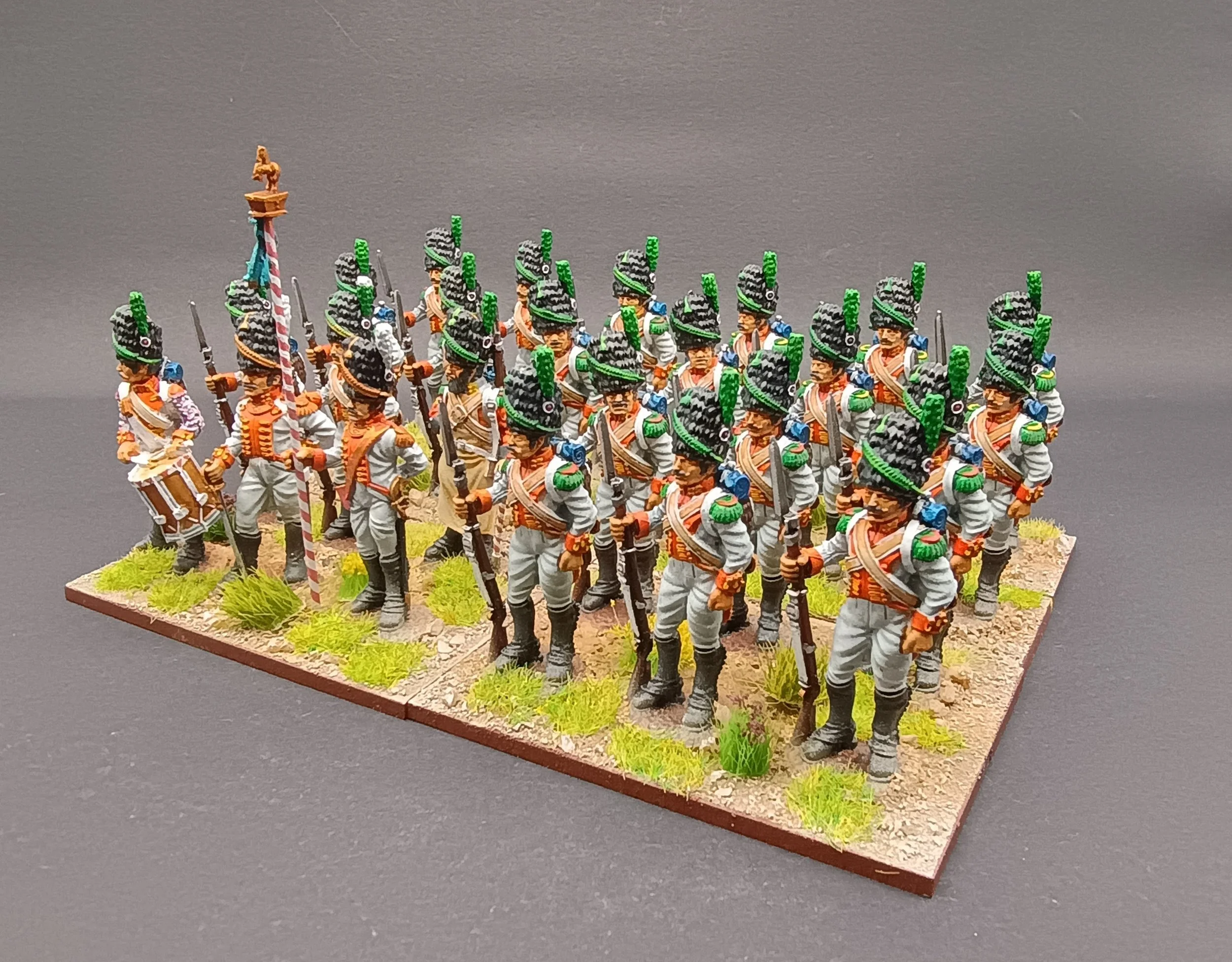
We thought it would be a great idea to build the Neapolitan field army for the battle of Tolentino, allowing us to showcase the splendour of the army’s uniforms (confusing though that subject can be), and give us the opportunity to refight a battle where there is such a numerical imbalance, it will be a challenge to stack the deck in favour of the numerically inferior force.
The plan is to showcase this battle at the Battleground show in November 2026.
A summarised Order of Battle is as follows:
Infantry of the Guard:
1/1 Velites
2/1 Velites
1/2 Velites
2/2 Velites
2 Battalions of Voltigeurs
Foot Artillery Battery
Cavalry of the Guard:
Guard Hussars
Guard Cuirassiers
Guard Lancers (it is somewhat unclear as to whether this unit were Guard Chasseurs or Guard Chevau-Legers, so we’re going with the rule of cool and picking lancers)
Guard Horse Artillery Battery
Infantry Division:
1/1 Line Infantry
2/1 Line Infantry
1/2 Light Infantry
2/2 Light Infantry
1/3 Line Infantry
2/3 Line Infantry
1/5 Line Infantry
2/5 Line Infantry
Foot Artillery Battery
Infantry Division:
1/4 Line Infantry
2/4 Line Infantry
1/1 Light Infantry
2/1 Light Infantry
1/7 Line Infantry
2/7 Line Infantry
1/8 Line Infantry
2/8 Line Infantry
Foot Artillery Battery
Cavalry Division:
1 Chevau-Leger
2 Chevau-Leger
3 Chevau-Leger
4 Chevau-Leger
Reserve:
1/4 Light Infantry
1/10 Line Infantry
1/11 Line Infantry
1/12 Line Infantry
We’ve made some assumptions and adjustments to make this work in terms of planning the game!
The plan is to use as much of our existing range as possible, along with some developments in the works. In upcoming blogs we’ll show you what we’ve used, and how we’ve used our range to make everything. Maybe even get some more painting guides uploaded!
In total there will be 26 infantry battalions of 24 figures, 7 cavalry squadrons of 12 figures and 5 artillery batteries.
It works out at slightly more than one unit per week throughout 2026, but luckily some units are already finished from our displays, so this should be achievable. To speed things up slightly, the reserve units will be dressed in greatcoats, everyone else in campaign or full dress.
Keep checking back for further updates!
